
In keeping with our sustainability efforts, we encourage you to use public transportation for Annual Alumni Week and not rent a car. It’s quite easy to get to and around Limerick using public transport!
We strongly encourage you to obtain travel insurance to cover all of your costs (not just flights) if illness or another emergency prevents you from attending Annual Alumni Week.
Shannon Airport Hotel: If flying out early in the morning from Shannon, the Park Inn by Radisson Shannon Airport is a convenient option, as it is located across the car park from the airport.
Stay Left! Even while you’re walking, remember traffic travels on the left side of the road—so look left, then right and left again before you cross!
Mobility Devices: If you need to rent a mobility device, The Mobility Shop delivers all over Ireland. When you book accommodation, let them know that a delivery is expected, and make sure all parties know the drop off / collection agreement.
Wi-Fi is readily available in public places, including transportation, and on campus at the university. We strongly suggest downloading WhatsApp and joining our Broadcast group (link is in your confirmation email).
Below, you will find some culture and driving/transportation tips from our Irish alumni, clicking each section to expand it.
View or download this information as a PDF here.
Irish Culture and Language
The first thing you need to know about Irish people is that we love to laugh, talk and have fun, and we try not to take ourselves too seriously. It is assumed on your arrival to Ireland that you have agreed to participate in “the craic”. Craic (pronounced “crack”) does not refer to crack cocaine or any other illegal substance. It’s a popular Irish term that refers to everything entertaining, newsworthy or fun. For the duration of your stay, we encourage you to enjoy “the craic” and to be “good craic”. In Ireland, the highest compliment a person can get is to be described as “great craic” and the lowest insult is to be “no craic at all” or a “craic killer”.
Everyone speaks English in Ireland, but our national language is “Irish” or Gaeilge (go-wail-ga). This is a very old Gaelic language, and it is spoken as a first language in areas called “Gaeltacht areas”. Irish place names are written on most signposts, and you may also encounter people with traditional Irish names. You might notice that these contain far too many consonants and are rarely pronounced as they are spelled. This is because we find it entertaining to hear non-Irish people trying to pronounce them. Just a bit of craic!
Irish name examples (pronunciation in brackets):
- Aoife (ee-fa) Odhrán (oh-rawn)
- Roisín (ro-sheen) Eoghan (owen)
- Saoirse (seersha) Tadhg (tie-g)
- Siobhán (sho-vawn) Ruaidhrí (roar-y)
- Caoilfhionn (key-lin) Dómhnall (doh-nal)
- Maedhbh (may-v) Pádraig (paw-rick or paw-drig)
- Aisling/Aishling (ash-ling) Oisín (usheen)
Arriving in Ireland and Transport
Buses: If you are arriving into Dublin, there are direct buses to Limerick (see UWPIAA reunion info). We strongly recommend booking bus tickets online ahead of time. Otherwise, you may find yourself negotiating with a bus driver, or worse, having to walk to Limerick, which is no craic at all!
Driving: When you arrive in Ireland, you will notice that we drive on the left. This is because we think it’s wrong to be right all
the time, and because it’s a bit of craic to confuse the tourists. Our rules of the road are similar to most other countries,
however, many Irish drivers prefer to make their own rules, so we encourage you to drive carefully and to stay alert. The
maximum speed limit is 120km/h (75mph) on motorways. National roads are 80km/h (50mph) and urban areas are usually 30-
50km/h (20–30mph). You may notice some exceptions to this. It is possible to find an 80km/h zone on a narrow country road
with grass growing up the middle, and a 50km/h zone on a main open road. There’s no good reason for this. Welcome to
Ireland!
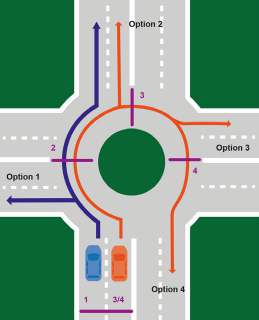
If you drive in Ireland, you will notice that we have a lot of “roundabouts” (known as traffic circles in some countries). Please remember to drive to the left, and to give way to traffic coming from the right. Here is a diagram that might be helpful when using lanes. Fuel: “Petrol stations” or “service stations” can be found in most towns and villages. There are very few service stations on motorways and in rural areas, so it’s best to fill up before a long drive. Fuel (gas*) available is petrol, diesel or electric charge. Larger service stations are a good place to stop to use the bathroom (washroom), grab a coffee or some food or just take a break. Service station bathroom standards vary. May the odds be ever in your favour! *In Ireland, “gas” usually refers to natural gas or bottled gas and is mainly used for heating and cooking. A person may also be referred to as “gas craic”. This is a big compliment!
Eating and Drinking
Meals: Our 3 main meals are breakfast, lunch and dinner. A “traditional” Irish breakfast includes bacon, eggs, sausages, potato bread, fried tomatoes, mushrooms and sometimes even baked beans. Toast is usually included. A continental breakfast is likely to include juice, fruit and a croissant/ pastry of some kind. A range of sandwiches, salads and soups are available for lunch in shops, cafes and sandwich bars. This can be anything from a simple sandwich to a gourmet freshly baked bread filled with local delicacies. Do explore and try some of the fabulous local cheeses, fish, relishes, vegetables and meats produced in Ireland. Gluten-free options are readily available all over Ireland and most restaurants and hotels cater for allergies and intolerances. Always let staff know before you order if you have allergies or intolerances.
Fast food: The fast-food chains in available in Ireland include McDonalds, Kentucky Fried Chicken, Subway, Domino’s Pizza, Apache Pizza, Burger King, Nando’s, Starbucks, and our very own—Supermac’s! Otherwise, there are many local eateries to experience during your stay.
Supermarkets: There are at least 5-6 different supermarket chains available in Ireland. Some of you will be familiar with Aldi and Lidl. Others in Limerick are Supervalu, Dunnes Stores, Spar and Tesco.
Drink: Ireland is famously home to many great craft beers, gins, whiskey and other alcoholic drinks…. the most famous of these being “Guinness” and “Irish whiskey”. Local brews are available around the country, and there is an ever-increasing range of non–alcoholic beers and drinks available in pubs and restaurants, including “Guinness 0:0” (non-alcoholic Guinness). The average cost of a pint of beer or Guinness can range from approx. €6 to €10, depending on where you buy it. Most draft beers /lagers/ales are served as a “pint” (568 ml) or “a glass” which is generally half a pint (284 ml). Many are available in cans or
bottles. A glass of house wine will typically cost approx. €6 to €8 in a hotel or bar. You can buy alcohol in supermarkets or in “off-licences” (liquor stores) between 10:30 and 22:00 Mondays to Saturdays and from 12:30 to 22:00 on Sundays. Children under 15 years are not allowed in bars after 22:00 in Ireland, unless they’re attending a private function where food is served. Smokers have to smoke outside. And on the UL campus there is no smoking or vaping permitted.
Coffee shops: It won’t take you long to find a decent coffee in any town. Most serve americanos, cappuccinos, lattes, flat whites, mochas etc. and lots will offer alternative forms of milk e.g. soya, oat etc. Some will encourage you to bring a “keep cup” to reduce the use of disposable coffee cups. A cappuccino typically costs around €3.50 – €4.00 “Irish coffees” are coffee with a dash of Irish whiskey, topped with cream. A “Bailey’s coffee” is coffee and Bailey’s Irish cream liquor. Stick with the nonalcoholic coffees if you’re driving! Tea is hugely popular in Ireland too, and it is a big part of our hospitality! Tea is offered in every home, and refusal of a cup tea is regarded an unforgivable offence! It is customary to politely (but unconvincingly!) refuse a cup of tea initially, but then to allow yourself to be persuaded. Tea is the solution to many problems in Ireland—there is nothing that can’t be discussed or resolved over a cup of tea! Herbal teas are available in most shops/cafes. “Afternoon tea” involves a long-standing tradition of serving tea, usually in China cups and saucers, with a wonderful plate of neatly cut sandwiches and home baked sweet delights.
Currency, Communication and Electricity
Currency: The currency used in Ireland is the Euro €, which is also used in many other parts of Europe. However, it is not used
in the northern part of Ireland, so if you are travelling to Northern Ireland as part of your stay, or to Scotland, England or Wales,
you will need to use Sterling pounds. Sterling pounds are not accepted in Limerick, or the southern part of Ireland.
- Credit cards, Revolut and debit cards are widely accepted throughout Ireland. In shops you can tap your card for purchases up to €50. For larger purchases you will need to use your card PIN.
- ATM bank machines are widely available. These will usually only supply Euro notes.
- There are 3 main mobile (cell phone) telecommunication providers in Ireland—Vodafone, Three and Eir. There are also 7 virtual network operators. If you are travelling from Europe, you may be able to use your phone on roaming networks.
- If travelling from USA/Canada, you may be able to buy Irish SIM cards for use during your stay. It is best to check rates
with your provider to avoid high phone charges. - Wi-Fi is widely available in hotels, restaurants and cafés.
- “WhatsApp” is a popular app used in Ireland for communicating via text or organising groups. This can be used for free in any Wi-Fi zone.
Electricity supply information in Ireland—Voltage is 230 v, Frequency 50 Hz, Plug/socket—3 square pins. Please take note that you may need an adapter for your phone charger or other electrical equipment
Recycling
Ireland was one of the first countries in Europe to introduce paying for plastic bags in supermarkets and encouraging shoppers to bring their own bags. You will not automatically be given a bag for your shopping unless you ask for it, and you will pay a small charge. We recommend that you bring your own reusable bag.
In early 2024, a “return system” was introduced to encourage shoppers to return their plastic bottles and cans. When you buy a bottle or can, you will pay a contribution towards recycling them. A lot of bigger shops have “return units” just inside their shops where you bring your clean bottles /cans back to and get a “voucher” for your “return”. It is like returning a deposit. You can then spend the voucher in the shop where you returned the bottles/cans. You do not need to return them to the same shop where you bought them.
Geography
In Ireland, we have 4 provinces—Leinster, Connacht, Munster and Ulster.
32 counties make up these 4 provinces.
- Ulster—Armagh, Antrim, Down, Derry, Fermanagh, Tyrone (Northern Ireland) and Donegal, Cavan and Monaghan
(Republic of Ireland) - Leinster—Dublin, Wicklow, Louth, Kildare, Carlow, Kilkenny, Laois, Longford, Meath, Offaly, Westmeath, Wexford,
Monaghan, - Munster—Cork, Waterford, Kerry, Limerick, Clare, Tipperary
- Connacht—Galway, Mayo, Roscommon, Sligo, Leitrim.
Driving north to south takes approximately 6 hours from the northern tip of Ireland to the southern tip, and approximately 4 hours to drive from Dublin on the east coast to the western tip of Mayo.
Ireland has a good system of main roads and motorways, but other secondary roads can often be bendy and picturesque! If you are travelling, allow extra time to enjoy the scenery and features along the way – particularly along the coast.
Irish Weather – predictably unpredictable!
- The weather in July is usually warm and mild. but we get a lot of rain, so you may experience many seasons in one day!
- It is advisable to wear layers that you can take off if the sun comes out.
- Wear sunscreen and always bring a raincoat or umbrella. You will probably need a sweater to wear in the evening.
- Sea swimming is very popular in Ireland. The water is cold, so if you are brave, pack the swimsuit and towel too!
And a few other things…
We don’t want to tell you everything before you get here—but most of you will know a few things that Ireland is famous for:
- musicians such as U2, Sinead O’Connor, The Wolfe Tones and Westlife
- Irish dancing and “Riverdance”
- “Game of Thrones”, “The Vikings” and “The Banshees of Inisherin”
- and sports, such as rugby, hurling, camogie and Gaelic football—to name just a few!
So come “have the craic” and explore the rest with us—we look forward to welcoming you in July!
Your Irish Pals